 |
|  | |||||||


 |  |
 |
 |
|
 |
|
 |
|
 |
|
 |
|
| | |||||||
| |
|
|
|
|
|
|
|
|
|
|
Librairie | Recherche

Entrez, de préférence, deux mots. |
Page 1 sur 3 - 50 articles.
| DICTIONNAIRE D'HERALDIQUE - 2012 | |||
Jean Paul Fernon | |||
 |
Le blason, dont le port est libre sous réserve du droit des tiers, est à présent largement répandu, non seulement dans les familles où il se transmet comme le nom, mais également dans l'industrie, le commerce, les communautés nationales, sportives, associatives et municipales. Symbole d'identification à un groupe social, esthétique par définition, il n'a pas pu être éliminé par les logos et les graphes dont la laideur et le mauvais goût, dans bien des cas, n'a que l'ignorance pour excuse…. De tout temps, blasonner a signifié célébrer et parler beau langage. Encore convient-il de l'apprendre. C'est ce que cet ouvrage propose. Il ouvre, à ceux qui en prendront la peine, la voie à des connaissances et des satisfactions d'honnête homme. C'est là une raison qui en passe bien d'autres. Environ 1800 termes de vocabulaire et 1200 dessins dans ce dictionnaire analogique très complet permettent aux profanes de mieux comprendre la science héraldique et aux initiés de parfaire leurs connaissances | ||
| |||

| DICTIONNAIRE D’HERALDIQUE – 2012 | |||
FERNON (Paul) | |||
 |
Le blason, dont le port est libre sous réserve du droit des tiers, est à présent largement répandu, non seulement dans les familles où il se transmet comme le nom, mais également dans l'industrie, le commerce, les communautés nationales, sportives, associatives et municipales. Symbole d'identification à un groupe social, esthétique par définition, il n'a pas pu être éliminé par les logos et les graphes dont la laideur et le mauvais goût, dans bien des cas, n'a que l'ignorance pour excuse…. Environ 1800 termes de vocabulaire et 1200 dessins dans ce dictionnaire analogique très complet permettent aux profanes de mieux comprendre la science héraldique et aux initiés de parfaire leurs connaissances. | ||
| |||
| HISTOIRE GENEALOGIQUE ET HERALDIQUE DES PAIRS DE France | |||
COURCELLES (Jean Baptiste de) | |||
 |
Support Numérique ; Géné Accès, est un nouveau service de mémoire et documents. Il s’agit d’un service d’intermédiation entre le fournisseur de l’ouvrage numérisé, et vous-même. C’est ce service de mise en relation uniquement qui est proposé par Mémoire et Documents. Mémoire et Documents ne se charge pas de la reproduction des documents et n’achète ni ne revend les dits documents, n’entrant dès lors dans aucune démarche de commercialisation desdits documents, ni directement ni sous licence. Le détail des conditions du service est disponible pour les clients particuliers de Mémoire et Documents sur simple demande. | ||
| |||
| COUTUMES ET DROIT HERALDIQUE DE L’EGLISE | |||
HEIM (Bruno Bernard) | |||
 |
Depuis la fin du XIIIe siècle, papes, cardinaux, archevêques, évêques, abbés, abbesses et autres dignitaires de l’Église catholique font usage du blason. Pour leur écu, ils adoptent celui de leur famille, un signe de leur origine géographique ou spirituelle, ou bien encore le programme de leur ministère (précisé par la devise). Cet écu est accompagné d’ornements extérieurs qui indiquent leur place dans la hiérarchie ecclésiale et manifestent la continuité de leur fonction malgré la succession des titulaires. Le blason ecclésiastique connaît un regain d’intérêt logique dans une société où l’image et la marque revêtent une grande importance. À la fois canoniste et artiste, Mgr Heim se fait ici à la fois descriptif et prescriptif ; l’ouvrage s’adresse donc aux historiens, aux amateurs de blason, d’art et d’histoire ecclésiastiques comme aux clercs de toutes confessions chrétiennes désireux d’imaginer des armoiries adaptées aux besoins de communication du XXIe siècle. | ||
| |||
| DICTIONNAIRE GENEALOGIQUE ET HERALDIQUE DES FAMILLES DU ROYAUME DE Belgique | |||
GOETHALS, F.V. | |||
 |
| ||
| |||
| L’HERALDIQUE A RUMILLY ET EN AUBE | |||
DAUNAY, Jean | |||
 |
Une intéressante petite brochure sur ce canton et ce département, leur histoire et leur symbolique héraldique, par un spécialiste de l’histoire locale. | ||
| |||
| L’HERALDIQUE ET SES ARCANES | |||
ESTAMPES, Claude René d' | |||
 |
L'héraldique a toujours eu pour but essentiel la reconnaissance visuelle des porteurs du blason. Elle a du, à l'époque, dans ce but vital, s'imposer un mode de simplification de formes et de couleurs, amenant ainsi adversaires et partisans, à une reconnaissance immédiate. Elle se doit pour garder son efficience première de conserver ces mêmes principes fondamentaux de simplification et de rigueur, car elle est en charge, d'identifier et de différencier l'esprit unique d’une famille. | ||
| |||
| D’ALERIONS EN ALERIONS, DIX SIECLES D’IMAGES HERALDIQUES LORRAINES | |||
BLANCHARD, Christophe | |||
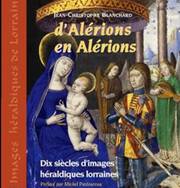 |
Le beau-livre de Jean-Christophe Blanchard nous montre comment l’héraldique a trouvé en Lorraine une terre d’élection et comment les armoiries y ont pris place sur des supports extrêmement variés : objets d’art et de la vie quotidienne, sceaux et documents d’archives, monnaies et médailles, livres manuscrits et imprimés, biens meubles et immeubles. À tous ces objets, documents et monuments, leur présence apporte une sorte d’état-civil. L’étude des armoiries, en effet, est parfois le seul moyen dont nous disposons aujourd’hui pour situer ces objets, ces documents et ces monuments dans l’espace et dans le temps. Remercions Jean-Christophe Blanchard et son éditeur pour cette belle et très utile publication. | ||
| |||
| L’HERALDIQUE ECCLESIASTIQUE | |||
ROURE, Baron du | |||
 |
| ||
| |||
| HERALDIQUE ET NUMISMATIQUE, | |||
LOSKOUTOFF, Y. | |||
Les monnaies et les médailles sont souvent ornées d’images armoriales. L’ouvrage présente de manière universitaire et accessible tout à la fois la rencontre de deux disciplines qui se mélangent et s’ignorent depuis toujours. | |||
| |||
| BLASONS, ART ET LANGAGE HERALDIQUE, | |||
JAILLARD, P., préface de M. PASTOUREAU, | |||
 |
L’héraldique présentée comme un dialecte graphique. Emblématiques, les blasons sont ici présentés à travers leur histoire depuis le moyen âge, leur composition, leurs usages et leur langage. Pierre Jaillard est Président du Conseil Français d’Héraldique. | ||
| |||
| LES MOTIFS DE L’HERALDIQUE, VARIATIONS ET COMPOSITIONS, | |||
GOMERIEUX, J.P. | |||
 |
L’héraldique est un art graphique, dont l’aspect visuel est primordial. Son langage est codifié, ancestral mais son usage se poursuit dans le monde moderne. Un véritable dictionnaire illustré de la science du blason. | ||
| |||
| HERALDIQUE ET NUMISMATIQUE, VOL II, | |||
LOSKOUTOFF, Y. | |||
 |
Ce second volume d'Héraldique et numismatique, Moyen Âge – Temps modernes étudie comme le précédent l'utilisation du blason dans les monnaies et les médailles, y ajoutant les sceaux. Le parcours commence en France (sceaux et monnaies de Louis IX à Charles V, pieds-forts de Philippe VI, devises des émissions monétiformes à la fin du Moyen Âge et frontispices de thèse au Grand Siècle). Il se poursuit autour de la France (monnaies dans l’orient latin, la Lorraine, la Bretagne, sceaux du clergé portugais). Il s’achève dans les Italies médiévales et renaissantes (Carrara de Padoue, patriarches d’Aquilée, bouclier antique ou écu médiéval dans les médailles du XVe siècle, médailles de Grégoire XIII). | ||
| |||
| HERALDIQUE MEDIEVALE BRETONNE, IMAGES, SCEAUX, ARMORIAUX ET TOMBEAUX, | |||
FABRE, M. | |||
 |
Une approche érudite pour présenter de nouvelles sources et des éléments inédits de l’héraldique du moyen âge en Bretagne. | ||
| |||
| PLAQUES DE CHEMINEE HERALDIQUES, | |||
PALASI, P. | |||
 |
L'auteur retrace l'histoire des plaques de cheminées armoriées, de leur apparition au XVIe siècle à aujourd'hui, en passant par l'évolution architecturale de la cheminée "à la française" au XVIIe siècle. Il présente 700 plaques héraldiques, qui constituent un réel patrimoine, témoin de l'identité des maîtres d'un lieu. | ||
| |||
| HERALDIQUE AUTOUR DU BASSIN DE THAU | |||
DAVID, J. et FERNON, J.P. | |||
 |
Ce mémoire réalisé en 2003 par Jacky David dans le cadre de l’Université du Temps Libre du Bas-Languedoc, et inédit jusqu’à ce jour, a été entièrement revu et agrémenté de nouveaux dessins de Jean-Paul Fernon. Il se veut une initiation sommaire à la science héraldique avec des exemples concrets pris parmi les blasons des communes, familles et communautés religieuses des sept cantons situés à proximité de l’étang de Thau : Sète, Frontignan, Montagnac, Pézenas, Mèze, Agde et Florensac. | ||
| |||
| REPERTOIRE DES RESSOURCES GENEALOGIQUES ET HERALDIQUE du département des manuscrits de la bibliothèque nationale de France - TOUS DERNIERS EXEMPLAIRES - NE SERA PAS REEDITE | |||
GERARD, Jean Philippe | |||
 |
Ce nouvel ouvrage est le résultat du dépouillement de l'ensemble des catalogues : fonds français et latin, collections d'érudits et de provinces, langues occidentales. Il présente une large sélection de références touchant à la généalogie et à l'héraldique.Précédés d'une présentation détaillée du fonctionnement du Département dont le lecteur novice tirera profit, et d'un historique du Cabinet des titres, ce sont plus de 13 300 manuscrits et 640 références bibliographiques, classées par thèmes (extraits de registres paroissiaux et de notaires, anoblissements, armoriaux, nobiliaires français et étrangers, recherches de noblesse, ordres de chevalerie, preuves de noblesse, monographies familiales, etc.) qui permettront non seulement au généalogiste et à l'héraldiste de tirer le meilleur parti des ressources conservées en ce lieu, mais encore le biographe, le prosopographe, l'historien local et celui des grandes institutions de l'Ancien Régime. | ||
| |||
| LES ECUS DES ARMES, LOGICIEL DE COMPOSITION HERALDIQUE ET GRAPHIQUE, VERSION EXPERT | |||
VINCENT PETIT, N. | |||
 |
NOUVEAU !! Version Expert : Cette nouvelle version très intéressante intègre un module de filtres très performant permettant un vrai travail sur les ombres et les courbures, 7000 dessins, 5200 meubles, un magnifique outil !! LOGIDESS OFFERT !! | ||
| |||
| HERALDIQUE AUTOUR DU BASSIN DE THAU, | |||
DAVID, J. | |||
 |
Ce mémoire réalisé par Jacky David, inédit jusqu’à ce jour, a été entièrement revu et agrémenté de nouveaux dessins de Jean-Paul Fernon. Il se veut une initiation sommaire à la science héraldique avec des exemples concrets pris parmi les blasons des communes, familles et communautés religieuses des sept cantons situés à proximité de l’étang de Thau : Sète, Frontignan, Montagnac, Pézenas, Mèze, Agde et Florensac. | ||
| |||
| HERALDIQUE MEDIEVALE BRETONNE, ARMORIAUX, SCEAUX, TOMBEAUX, | |||
FABRE, M. | |||
 |
Un monument sur l’héraldique bretonne, par une spécialiste, chercheuse sur le sujet, bretonne d’origine et passionnée d’héraldique et de sigillographie. | ||
| |||
Page 1 sur 3 - 50 articles.


|
Sommaire Librairie Edition/Diffusion Recherches Articles Tables des Noms Contacts presse Informations Légales |
 |